

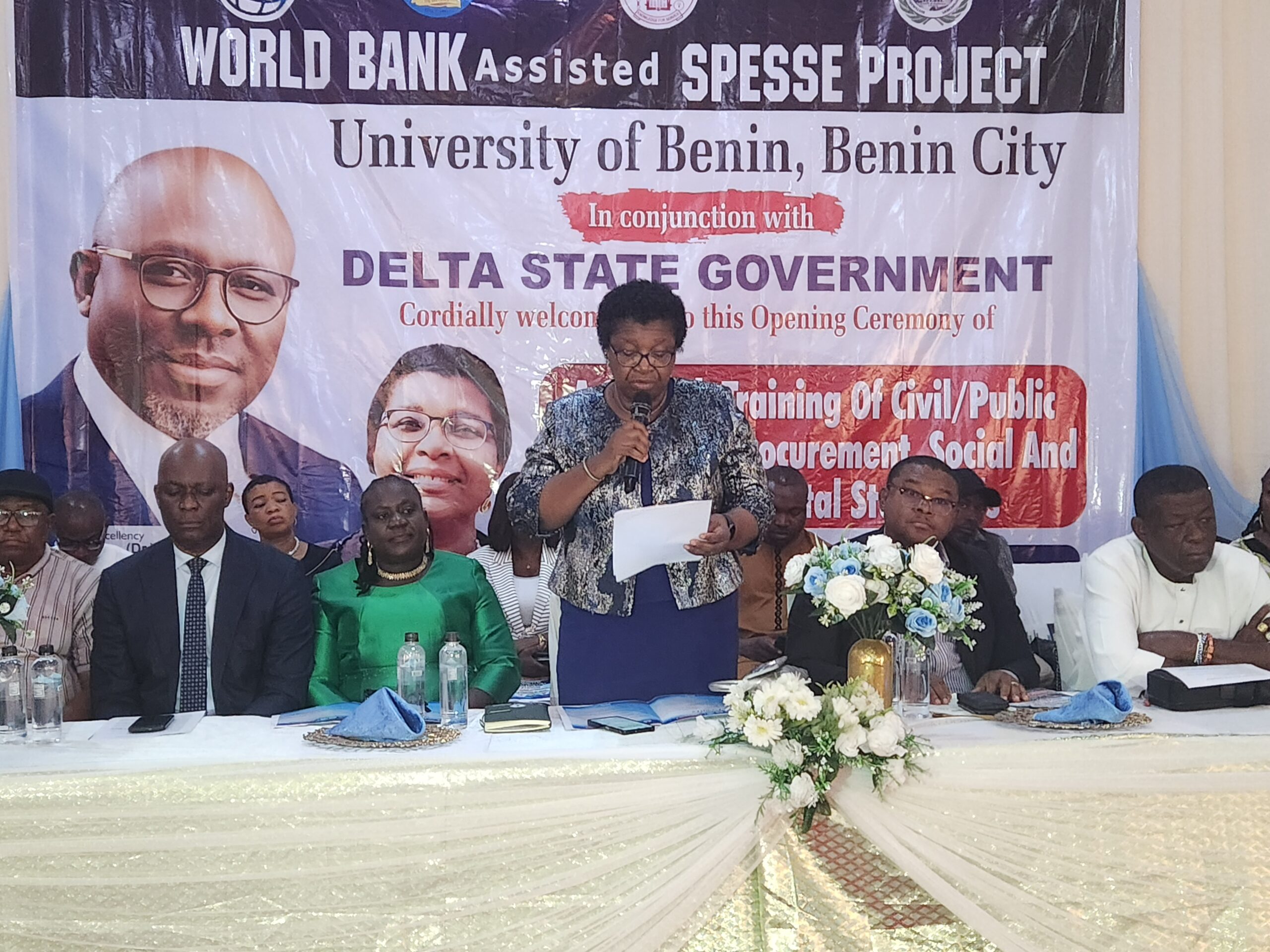







By Sufuyan Ojeifo
Revolutions in government rarely arrive with brass bands. They slip in without fanfare, often disguised as login credentials and course modules.
One day, a procurement officer in Kano is fumbling through paper files. A few months later, she is navigating an e-procurement dashboard with the calm assurance of someone who understands both the rules and the reasons behind them.
In Lagos, a young professional who once treated environmental safeguards as bureaucratic footnotes now debates them with conviction.
And somewhere in Pakistan, a public official signs into a Nigerian certification portal and takes an examination designed in Abuja.

If that last image does not make you pause, it should. Because that is how you know something subtle but profound is happening.
The Sustainable Procurement, Environmental and Social Standards Enhancement programme, better known as SPESSE, was never meant to be a slogan. It was conceived as architecture. Architecture, if properly designed, does not shout. It endures.
● From Convocation to Momentum
Late January 2026 brought policymakers, development partners, and newly certified procurement professionals together at the State House Banquet Hall. The occasion was the NPCP Convocation, marking the first cohort of graduates from Nigeria’s National Procurement Certification Programme (NPCP).

Yet the real story was not the ceremony. It was what the ceremony confirmed. After years of fragmented efforts, from the Budget Monitoring and Price Intelligence Unit of 2001 to the Procurement Cadre of 2005, the Public Procurement Act of 2007, and the University of Turin collaborations of 2019 and 2020, Nigeria’s procurement professionalisation agenda has finally acquired both momentum and structure.
Each previous attempt added something valuable. Yet the gaps persisted: weak system performance, no harmonised capacity building, inadequate critical skills. SPESSE was designed in 2020 to break that cycle.
Speeches delivered that day by Dr Adebowale Adedokun, Director General of the Bureau of Public Procurement, and by Senator Ibrahim Hassan Hadejia, Deputy Chief of Staff in the Presidency on behalf of the Vice President, Kashim Shettima, were not mere formalities. They contained policy signals and hard data. Strip away the pageantry, and what remains is unmistakable: procurement reform has moved from aspiration to institutional habit.
● A Certificate Crosses Borders
Consider the development that quietly stole the show at a recent professional procurement certification exam. A diaspora-based participant from Pakistan successfully earned certification under Nigeria’s NPCP.
It began with a cautious inquiry to the National Coordinator at the BPP, Mr Babatunde Oladele. Was the candidate eligible? What were the requirements? Could the system accommodate a remote participant?
Yes. Yes. And yes.

A professional in South Asia verified eligibility, navigated the Nigerian digital platform, completed the required assessments, and demonstrated proficiency in Nigeria’s procurement frameworks. No ribbon cutting. No diplomatic communiqué. Yet the symbolism was potent. A system built to cure domestic quackery had become credible enough to attract international interest.
This outcome sits squarely within the reform vision of Dr Adebowale Adedokun. For years, procurement in Nigeria operated with uneven standards. Training was sporadic. Accountability was selective. Professionalisation was more aspiration than reality.
The wager was straightforward: build systems so credible that bypassing them becomes costly. Replace discretion with structure. Replace improvisation with certification. Digitise the process so that geography no longer matters.
That wager is beginning to yield returns. When a Pakistani official opts to sit for a Nigerian procurement examination, he is not indulging in curiosity. He is recognising a benchmark.
● Numbers with Consequence
Since the NPCP online platform went live in April 2025, 2,075 officers were trained and certified in the final quarter of that year alone. More than 6,500 Nigerian officers are (currently) in training, with certification targeted for the first half of 2026.


It is tempting to treat these as just tidy statistics. That would be a misreading of what is really happening.
Each certified officer returns to a ministry, department, or agency with altered instincts. Faced with a procurement file, they are no longer merely processing paperwork. They are applying a framework that connects directly to the government’s reform priorities: the Nigeria First Policy promoting local content, affirmative procurement provisions for women and youth, the debarment framework holding erring contractors accountable, and the Price Intelligence and Benchmarking System strengthening fiscal discipline. They grasp environmental and social safeguards as enforceable standards rather than ornamental clauses.
In a country where public procurement accounts for a significant share of government expenditure, this is not cosmetic reform. It is structural reinforcement.


At the convocation, Vice President Kashim Shettima, who was represented by his Deputy Chief of Staff, Senator Hadejia, captured it succinctly: “Public procurement sits at the heart of governance. It is the bridge between public policy and public impact. When procurement systems are weak, development stalls. When they are strong, transparent, and professional, nations thrive.”
That is not rhetoric. It is arithmetic.
● Reform that Outlives the Applause
For the first cohort of NPCP graduates, certification is not merely a career milestone. It is a charge: to uphold professional standards, resist shortcuts, and treat procurement as a strategic instrument for delivering public value.
The 2,075 certified officers are not decorative figures. They are custodians of a new culture embedded across MDAs. The 6,500 in training represent continuity rather than episodic reform. And the Pakistani certificate holder stands as evidence that standards drafted in Abuja can command attention in Islamabad.
For a country long accustomed to importing templates and exporting talent, that reversal carries significance.
With additional financing from the World Bank secured through June 2029, SPESSE has acquired what many reforms lack: time to consolidate and institutionalise. Nigeria is presently reviewing its Public Procurement Act, refining thresholds and advancing sector-specific reforms. These technical adjustments will demand professionals who understand both the letter and the spirit of the law. Certification, in this context, becomes less a badge and more a necessity.
● The SPESSE Effect
Institutional reform rarely provides cinematic moments. It looks instead like dashboards being updated, officers studying for examinations and systems quietly hardening against abuse.
That is the SPESSE effect.
A system sturdy enough to travel. A framework credible enough to attract. A culture disciplined enough to endure.

If someone in Pakistan sees value in logging into a Nigerian certification portal, the more urgent question may be whether we fully appreciate what is being built at home.
The most consequential revolutions are often the ones that end up exporting standards rather than slogans. The absence of fanfare should not diminish what Nigeria’s SPESSE has accomplished so far.
● Sufuyan Ojeifo, a communications consultant with BPP, can be contacted at [email protected].