


The Covenant Applied Informatics and Communication Africa Centre of Excellence (CApIC-ACE) recently conducted an Orientation and Re-orientation Programme for new and returning postgraduate students, marking the official commencement of the 2025/2026 academic session.
Reaffirming its commitment to academic excellence, impactful research, and capacity building in Africa, the Centre introduced its newly admitted postgraduate students to the its three research clusters: Malaria, Cancer, and Fedgen encouraging them to align their research with CApIC-ACE’s goals, which include developing new treatments and diagnostics for malaria, breast and prostate cancers; advancing genomic and cloud-based solutions to customise and process genomic data to address health challenges, training of African scientists, and empowering communities through public health education.
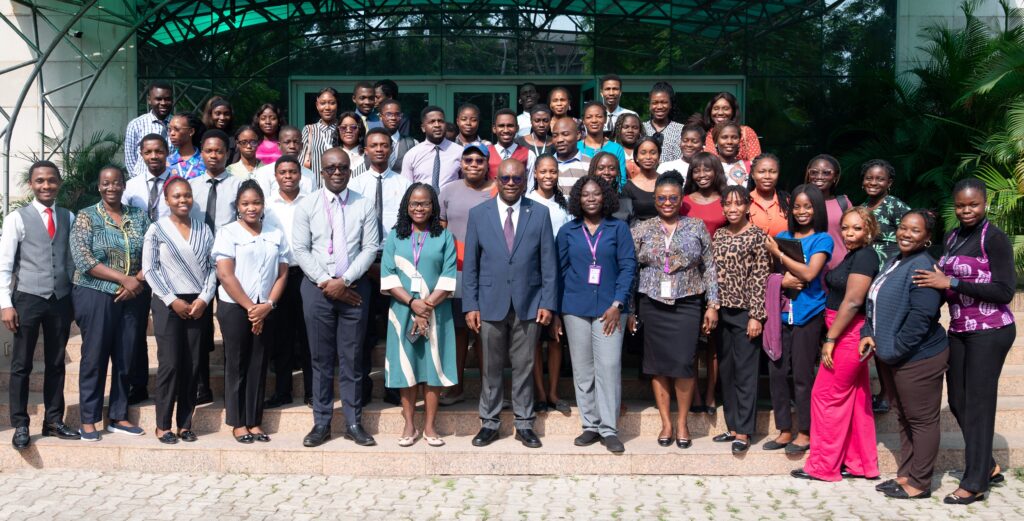
The programme, which took place at the Covenant University Centre for Research, Innovation and Discovery (CUCRID), Covenant University, Ota, Nigeria, brought together members of the Centre’s leadership, faculty, and over forty postgraduate students, featuring four key presentations designed to prepare and strengthen students’ academic and research integration.
Delivering the opening remarks, the Centre Leader, Prof. Emeka Iweala, who warmly welcomed participants, outlined the vision, mandate, and multidisciplinary nature of CApIC-ACE. He highlighted that the Centre, hosted by Covenant University, operates within a world-class, research-intensive environment that significantly supports its activities. Prof. Iweala explained that CApIC-ACE offers programmes spanning biochemistry, bioinformatics, microbiology, chemistry, and information and communication engineering, and is funded under the World Bank ACE Impact Project to drive research in critical thematic areas including malaria, breast and prostate cancer, cloud computing, and high-performance computing (HPC). He encouraged students to actively engage, ask questions, and make the most of the orientation.
Prof. Iweala further explained that while the World Bank scholarship model has ended, new students will receive a 50% tuition discount with full laboratory access. He informed participants of ongoing efforts to secure funding under the proposed ACE Innovate phase to restore scholarship benefits and reminded students to uphold Covenant University’s core values.


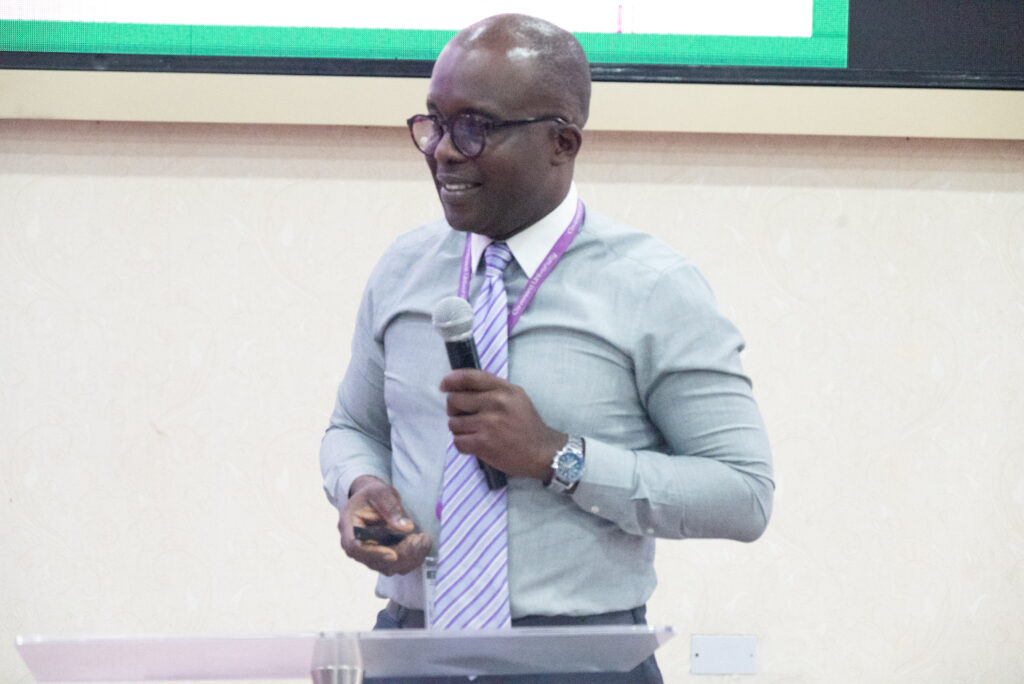
In a presentation titled “Research Culture at CApIC-ACE: Ethics, Proposal Writing and Grant Applications”, the Applied Research Coordinator, Prof. Solomon Rotimi, emphasised that research excellence is central to the Centre’s mandate and stressed the importance of ethical research conduct, responsible data handling, and academic integrity. He underscored proposal writing and grant acquisition as essential competencies for all CApIC-ACE scholars, noting their role in strengthening research capacity, accountability, and competitiveness. He listed names of CApIC-ACE Scholars who had won grants over the years, urging the students to interact and learn from them. He concluded by reiterating the importance of securing ethical approvals before commencing research.

The Monitoring and Evaluation Officer, Prof. Olubanke Ogunlano, who spoke on the academic expectations, research responsibilities and other obligations of a CApIC-ACE Scholar, informed the participants that the Centre demands high academic commitment and research rigour, emphasising impact, integrity, and timely completion to drive meaningful contributions. Scholars were told to maintain a strong CGPA of 4.0 or above to progress from a Master’s degree to a PhD, reflecting serious academic engagement. Master’s students are expected to complete within two years, and PhD students within three years. Students were also admonished to actively participate in seminars and submit monthly reports by the 27th of each month. Prof. Ogunlano started that research endeavours must be relevant, innovative, ethical, and aligned with the Centre’s objectives, focusing on real-world impact and product development. Publications are required in Scopus-indexed journals, prioritising high-impact outlets, and the Centre’s support must be acknowledged to enhance visibility and funding transparency.
He also highlighted the need for internal and external collaborations, with the Centre’s affiliations prominently displayed on all scholarly outputs. She mentioned capacity building through workshops, conferences, exchanges, and grant applications as mandatory to develop well-rounded scholars. Importantly, the need for professional ethics and research integrity was emphasised as a must to prevent retractions, plagiarism, or falsification, and protect the Centre’s reputation. The Freshmen were also enlightened about the funding caps of US$3,000 for master’s and US$6,000 for PhD students, with all expenditure requiring transparent documentation for auditing and clearance. The participants were happy to hear that the Centre supports group projects in computational fields. Prof. Ogunlano ended her address by reiterating that CApIC-ACE scholars are ambassadors for the Centre and must seek permission for absences, maintain professionalism, and actively engage in Centre activities. She added that timely completion and deliverables are a priority to maximise resource use and ensure students graduate on schedule, with exemplary students celebrated publicly.
The last presentation on Health, Safety, and Laboratory Compliance was taken by the Environmental and Social Safeguards Officer, Prof. Obinna Nwinyi, who advised CApICE-ACE Scholars on strict adherence to the Environmental and Social Safeguard Plan (ESMP) and health and safety protocols, as mandatory to ensure safe and sustainable research practices. The speaker stated that the Centre follows ESMP policies monitored by the World Bank to enhance positive impacts and mitigate negative environmental and social risks. He said the ESMP integrates policies, quality control, stakeholder involvement, and reporting mechanisms to ensure compliance and continuous improvement aligned with ISO 4001 standards. He informed the participants that gender-based violence and sexual harassment were strictly prohibited with clear reporting channels and consequences, to maintain a safe, respectful environment. Also, participants were enlightened on the procedures for handling disputes and complaints confidentially, with escalation to legal authorities if necessary.
The Centre Leader, Prof. Iweala, later returned to present a comprehensive overview of CApIC-ACE’s vision, structure, policies, and achievements. Established in 2018, the Centre received World Bank funding of approximately US$6.7 million, following strong performance under the ACE Impact Project, which concluded in 2025. He highlighted the Centre’s impact, including the enrollment of over 200 postgraduate students, the training of more than 300 African scientists, and the engagement of over 3,000 community members on malaria and cancer awareness. The Centre’s robust governance structure, international advisory boards, and partnerships with global technology leaders such as Microsoft, IBM, and Google to enhance research relevance and internship opportunities were also emphasised. Participants were introduced to CApIC-ACE’s state-of-the-art research infrastructure, comprising seven ultra-modern laboratories, including cancer genomics lab, Insectary, In-Vitro lab, molecular biology lab, chemistry lab, and tow Fedgen laboratories which also doubles as the data center and HPC equipped with advanced facilities such as a unique 4000 MHz NMR machine, next generation sequencers, bioanalysers, PCR machines, and HPC facilities which generate revenue by hosting external institutions.
Among the Centre’s notable achievements highlighted were:
- CApIC-ACE scored a near-perfect 99.9% performance rating on the ACE Impact project, earning an additional US$731,743 and a perfect 5/5 development impact score.
- The Fedgen Group were commended for contributing to the four research projects exhibited at the ACE at 10 celebrations in Ghana in 2025.
- Internships facilitated for over 140 students and 24 faculty members.
- The biochemistry programme holds two international accreditations from the Royal Society of Biology, while other programmes are nationally accredited with plans for further international recognition.
- Research progress: identification of unique molecular signatures of breast and prostate cancer in Nigerian patients. These signatures will be developed into clinical biomarkers in health. For malaria, new molecular targets in malaria vectors and parasites identified for potential drug and insecticidal agent development. While the Centre has successfully designed and deployed the Fedgen HPAC with AI facilities. Institutions now come and host their infrastructure on our HPC.
- The Centre, through research, has contributed to the national guideline and policy on cancer treatment in collaboration with the National Institute for Cancer Research and Treatment (NICRAT), Abuja, and one of the Centre’s faculty, Prof. Rotimi, was appointed as a consultant to NICRAT.
- Over 80 Scopus-indexed papers have been published, with faculty members inducted into prestigious academic societies and listed among Nigeria’s top AI researchers.
- The centre is currently hosting an international postdoctoral fellow in malaria research.
- Over 100 of our students have been awarded fellowships, grants, international internships, and have also attended national and international conferences.
- Recorded zero sexual harassment and zero gender-based violence among faculty, staff, and students.
- Introduced three new academic programmes in 2025, namely: bioinformatics, chemoinformatics, and microbial genetics and biotechnology – expanding capacity building.
A critical aspect of the presentation was laboratory safety protocols, which addressed risks from hazardous chemicals, carcinogens, reproductive toxins, and other toxic agents, emphasising proper handling, storage, and disposal. According to Prof. Nwinyi, the Centre enforces a chemical hygiene plan requiring the use of personal protective equipment (PPE) such as lab coats, gloves, goggles, and proper footwear to minimise exposure.
The programme concluded with an interactive question-and-answer session, during which the Centre reaffirmed its commitment to sustaining research infrastructure, supporting group projects, facilitating publications, assisting with grant and fellowship applications, and maintaining rigorous safety and ethical standards.